
Ratio of Offensive to Defensive Efficiency Equals Power
The offensive and defensive efficiencies are in fact independent parameters. Each season, some teams have good offensive efficiencies but poor defensive efficiencies. Other teams post poor offensive values and good defensive. A few teams are poor in both respects and a few are strong in both areas. Both values reflect the team's overall and individual talent levels; however, the offensive and defensive abilities are functions of different elements and aspects of that talent pool.
Offensive performance is efficiency based. As such, offensive efficiency is a function of an individual player's athletic skills including eye-hand coordination, strength, quickness, and jumping ability. We prefer to think about offense as most effective when the output is a product of team work. However, many outstanding offensive players seem to display a healthy dose of a “Me-Focused” temperament. The great University of Michigan teams led by Cazzie Russell in the mid-sixties prove the point. FN1 Pistol Pete Maravich, clearly the most prolific offensive player in the history of the NCAA, was totally “Me-focused” during his time at LSU.
On the other hand, defensive performance is effectiveness based. Defensive effectiveness is a function an individual player's athletic skills including quickness and agility. Defense depends on teamwork to a greater extent than offensive efficiency because of the reactive nature of defensive work. The best defensive teams demonstrate healthy “We-Focused” temperaments.
The most powerful basketball teams are those that are both highly efficient on offense and highly effective on defense. Similarly, weak teams have low offensive efficiency and little defensive effectiveness. Therefore, the ratio of a team's offensive efficiency to the team's defensive effectiveness provides an objective measure of a team's power. The table below illustrates how high, average and low offensive and defensive abilities translate into power.
Power Rating As Function of
Offensive and Defensive Efficiencies
|
Average Defensive Effectiveness |
Average 0.75
Very Weak |
Offensive 0.85
Average |
Efficiency 0.95
Very Strong
|
0.75
|
1.00 |
1.13 |
1.27 |
0.85
|
0.88 |
1.00 |
1.12 |
0.95 |
0.77 |
0.90 |
1.00 |
As this Table illustrates, the most powerful teams are those that solve the human conflict between the essential total teamwork commitment required for sustained defensive effectiveness, and the natural “Me-Focused” temperament to sustain offensive efficiency. Each year, a relatively few teams master both and become great college basketball teams. The good teams each year are those that are average to very strong in each area, but not very strong in both. All other teams have average or lower offensive and/or defensive ability.
Recent Kentucky teams have produced the following power ratings for their entire seasons.
Kentucky Power Ratings in Recent Years
Season |
Power |
Wins |
Loses |
Rating
|
|||
2005 Season Stats |
119.2% |
27 |
5 |
2004 Season Stats |
115.1% |
27 |
5 |
2003 Season Stats |
115.7% |
32 |
4 |
2002 Season Stats |
110.3% |
22 |
10 |
2001 Season Stats |
114.1% |
24 |
10 |
2000 Season Stats |
108.2% |
23 |
10 |
1999 Season Stats |
119.4% |
28 |
9 |
1998 Season Stats |
118.2% |
35 |
4 |
1997 Season Stats |
128.1% |
35 |
5 |
1996 Season Stats |
128.5% |
34 |
2 |
1995 Season Stats |
122.8% |
28 |
5 |
1994 Season Stats |
117.4% |
27 |
7 |
1993 Season Stats |
120.9% |
30 |
4 |
1992 Season Stats |
115.9% |
29 |
7 |
1991 Season Stats |
109.1% |
22 |
6 |
1990 Season Stats |
102.7% |
14 |
14 |
1989 Season Stats |
97.2% |
13 |
19 |
1988 Season Stats |
113.4% |
27 |
6 |
1987 Season Stats |
101.9% |
18 |
11 |
1986 Season Stats |
116.7% |
32 |
4 |
1985 Season Stats |
99.9% |
18 |
13 |
1984 Season Stats |
120.0% |
29 |
5 |
1983 Season Stats |
119.4% |
23 |
8 |
1982 Season Stats |
104.4% |
22 |
8 |
1981 Season Stats |
103.8% |
22 |
6 |
1980 Season Stats |
113.0% |
29 |
6 |
1979 Season Stats |
106.8% |
19 |
12 |
1978 Season Stats |
118.3% |
30 |
2 |
1977 Season Stats |
116.3% |
26 |
4 |
1976 Season Stats |
101.5% |
20 |
10 |
1975 Season Stats |
113.6% |
26 |
5 |
1974 Season Stats |
98.0% |
13 |
13 |
1973 Season Stats |
109.6% |
20 |
8 |
1972 Season Stats |
112.2% |
21 |
7 |
Average |
112.8% |
24.8 |
7.5 |
Maximums |
128.5% |
35.0 |
19.0 |
Minimums |
97.2% |
13.0 |
2.0 |
Standard Deviations |
8.31% |
6.0 |
3.8 |
The 2003 Kentucky basketball team struggled to find its defensive identity for the first nine games of the season, Kentucky had a respectable offensive efficiency of 0.92 ppp; however, their defensive effectiveness averaged 0.88 ppp. Subsequent to the Louisville game, Kentucky 's defensive effectiveness dropped to 0.76 ppp while the offensive efficiency rose to 0.95. Certainly, Kentucky improved their offensive productivity, but a 3 percent increase may not be statistically significant. However, there is no denying the significance of the defensive effectiveness falling [improving] by over 16 percent. During the first 9 games, Kentucky 's defense was softer than average. The defensive effort since the Louisville game was clearly among the best in the NCAA that season.
The power rating after the first 9 games was 1.05 and the power rating after the Louisville game was 1.25. This change in defensive intensity converted an average Kentucky team through nine games into a truly outstanding team over the last 23 games of the pre-NCAA season. The following graph illustrates the relationship between offensive efficiency, defensive effectiveness, and power ratings. The diagonal lines divide the power areas into team categorings as follows:
Relationship of Power Rating to
Offensive [Horiz. Scale] and Defensive [Vert. Scale] Efficiencies
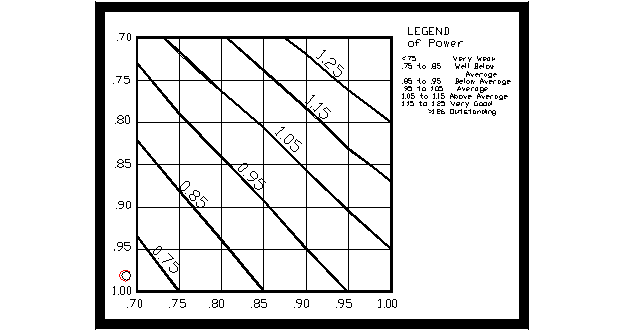
This graph is based on season long average power ratings, not game to game power ratings. On any given night, a particular team's performance will vary around these means. For example, the 2003 Kentucky team has a mean power rating of 1.18 with a standard deviation of 0.28. This means that the vast majority of Kentucky 's game performances [29 of 36] fall within a range of 0.91 to 1.46 [Mean +/- 1 Standard Deviation]. However, Kentucky had four games with power ratings below 0.91, and on each occasion Kentucky lost that particular game. It is noteworthy that Kentucky won two games during the season with game power ratings of between 0.91 and 1.00 [Athletes In Action (0.93) and at Florida (0.99)]. FN3 Similarly, Kentucky had three games with game power ratings above 1.46.
The ratio of offensive to defensive efficiency measures a team's power. Teams with power ratings above 1.15 are very good, and strong. Teams with power ratings above 1.25 are outstanding.
The strength of schedule appears to provide a significant factor to a team's power rating. To compare power ratings, team to team, one must factor the schedule strength. I am currently evaluating alternative SOS relationships.
Footnotes:
1. Cazzie Russell led the University of Michigan to college basketball's promised land in 1965 and 1966. In 1966, Michigan lost to UCLA in the championship game. In 1966, Michigan lost in the Mid-East Regional final to Kentucky 's Rupp's Runts team. Many times during those two seasons, Michigan either trailed or held a slim lead with 10 miinutes remaining in the game. For the first 30 minutes, Cazzie shared the ball with his teammates; however, the last 10 minutes are for Cazzie, and he would simply step up, take over the game on offense, and lead Michigan to one of their frequent victories.
2. In 2003, Kentucky started its season with a loss in one of its pre-season exhibition games, and after nine regular season games, Kentucky stood at 6 – 3 after its 18 point defeat to Louisville . Subsequent to the Louisville game, Kentucky began a winning streak that stood at 23 when the NCAA tournament began, including undefeated in the SEC regular season and tournament, a first in 51 years, and not even the great 1996 National Championship Kentucky team can boast this accomplishment to its long list of credits. Since the Louisville loss, Kentucky 's power rating has been 1.25. Kentucky found its defensive commitment at half time of its game against Vanderbilt in Nashville . After trailing by as much as 14 points in the first half, and by 8 points [28 – 36] at half time, Kentucky held Vanderbilt to only 16 points in the second half and won easily by 22 points. Since this Vanderbilt game, Kentucky has posted a power rating of 1.26. Through five post season games in 2003, Kentucky has an average power rating of 1.35.
3. Kentucky was able to win two games with game power ratings below 1.00 on the strength of superior offensive rebounding which provided bonus possessions, 3 in the Florida game and 7 in the AIA game.

Copyright 2004 Richard Cheeks
All Rights Reserved